


Artificial Intelligence
Trinity Sixth Form Academy’s Approach to Artificial Intelligence (AI)
Artificial Intelligence (AI) is becoming an important part of education, work, and everyday life. At TSFA, we take a forward‑thinking yet responsible approach to AI. We encourage students to make use of AI tools to support their learning while ensuring that safety, ethics and academic integrity always come first.
Our Principles for Using AI
Our approach is guided by national recommendations from the Department for Education and aligns with the Trust-wide AI policy. We are committed to:
- Safety, security and wellbeing – Protecting users and their data, ensuring systems are robust and monitored.
- Transparency and fairness – Being clear when AI is used and making sure tools are unbiased and ethically appropriate.
- Human oversight – Ensuring that AI supports, rather than replaces, expert teaching and human judgment.
- Preparing students for the future – Helping students develop digital literacy and critical thinking skills for a world where AI is commonplace.
How Students Are Encouraged to Use AI Responsibly
Students are allowed and encouraged to use AI—when done ethically. AI can be a powerful tool to support learning, but it must never replace a student’s own thinking.
Examples of Appropriate and Helpful AI Use
- Exploring new ideas and topics
- Getting simplified explanations of complex concepts
- Checking spelling and grammar (with human double‑checking)
- Creating revision materials such as flashcards
- Summarising long texts
- Getting support with tricky texts
- Using AI as a “revision coach”
- Generating ideas for projects, job applications or UCAS personal statements (but not writing them)
Key Expectations for Students
Students should always:
- Be honest – Declare when AI has been used in their work
- Verify accuracy – AI can be incorrect; facts must be checked
- Be original – Work must be based on the student’s own ideas
- Think critically – Evaluate, fact‑check, and revise AI responses
- Stay safe – Never input personal or sensitive data into public AI tools
AI Must Not Be Used For
- Submitting AI-generated work as your own
- Copying and pasting large sections of AI content without understanding it
- Using AI in exams, assessments or tests
- Entering any student or staff data into public AI systems
- Writing UCAS statements or coursework
Misusing AI, especially involving plagiarism or data breaches, may result in serious disciplinary action.
Recommended AI Platforms for Students
Students are encouraged to use the following AI tools:
- Microsoft Copilot (College Account – Recommended First Choice)
- A closed, secure system
- Safe for proofreading, feedback and generating ideas
- Links directly to OneDrive and Teams
- Can be used for proofreading assignments or personal statements (closed system)
- Very versatile and widely used
- Draws on broad internet information
- Useful for explanations, ideas and revision support
- Not to be used for proofreading assignments or personal statements (open system)
- Strong for image generation, diagrams and research
- Excellent for careers and UCAS information
- Not to be used for proofreading assignments or personal statements (open system)
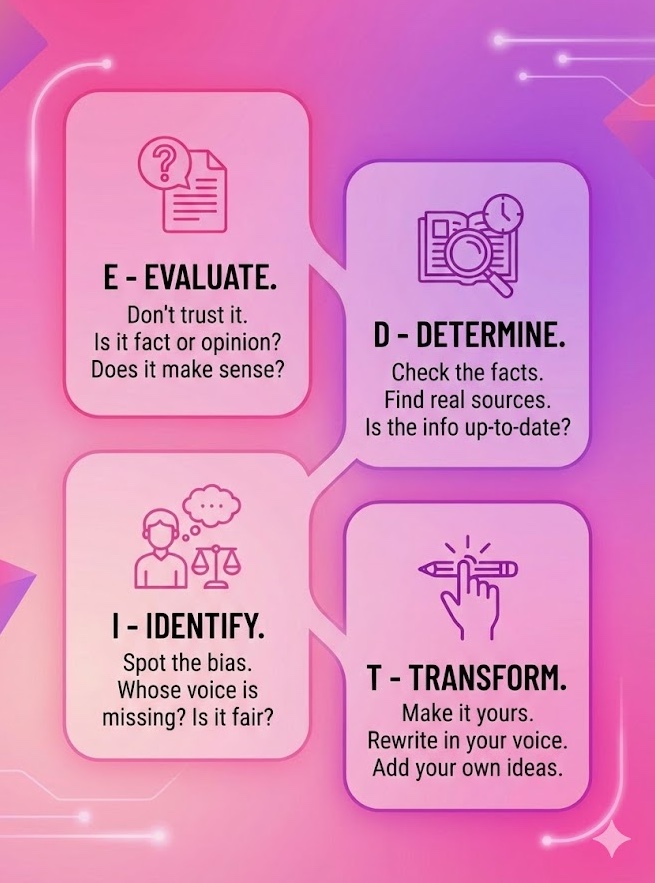
A Helpful Framework: The EDIT Process
Students are encouraged to use the EDIT model when working with AI:
- Evaluate – Check the relevance and quality of the response
- Determine – Fact-check information using reliable sources
- Identify – Look for bias and challenge inaccuracies
- Transform – Rewrite information in your own words and build on it
Why Responsible AI Use Matters
While AI can be incredibly useful, it also comes with risks if used carelessly:
- Inaccuracy – AI can produce wrong or misleading answers
- Bias – AI might reflect stereotypes or unfair assumptions
- Plagiarism – Passing AI’s work off as your own is cheating
- Data risks – Public AI tools may store or reuse anything you enter
- Over-reliance – AI can’t replace real learning or teacher expertise
Using AI responsibly helps students develop the skills, judgement and integrity needed for university, apprenticeships and future careers.
In Summary
At Trinity Sixth Form, AI can be used—but it must be used ethically.
Students should show integrity, protect data, think critically and ensure AI enhances rather than replaces their own learning.
This policy reflects good practice guidelines/recommendations in the following publications:
AI regulation white paper, published by the Department for Science, Innovation and Technology, and the Office for Artificial Intelligence
Generative artificial intelligence (AI) and data protection in institutions, published by the Department for Education (DfE)
Using AI in Education: Support Materials published by the Department for Education (DfE)
This policy also meets the requirements of: UK General Data Protection Regulation (UK GDPR) – the EU GDPR was incorporated into UK legislation, with some amendments, by The Data Protection, Privacy and Electronic Communications (Amendments etc) (EU Exit) Regulations 2020